





《파리 Flyers》
방정아 · 주한별
2026.05.01 – 06.20.
12:00-19:00 (일, 월 휴관)
기획: 허호정
협력: 권혁규
진행: 권하정, 한희
그래픽 디자인: 인현진
전시 설치: 김병찬, 조형준, 김대근
주최, 주관: 뮤지엄헤드
후원: 한국문화예술위원회, 2026 시각예술창작주체
(…) 바로 그때
파리 한 마리가 끼어들었다 –
(…) 빛과 – 나 사이에 –
그리고 창문이 고장났다 – 그러고 나서
나는 보기를, 볼 수가 없었다 –
에밀리 디킨슨, “I heard a Fly buzz – when I died” (1863) 중[1]
이미지, 어떤 이미지는 마치 파리와 같다. 어느샌가 끼어들어 와 성가시게 하고, 이따금 새카맣게 떼로 모여 있어 정체의 분간조차 어렵다. 그것은 안전한 현재를 건드리는 모종의 불경함을 실어 나른다. 그런 이미지들이 나부끼는 동안, 세계를 이전과 같이 보기는 어려워진다. 죽음의 순간, 귓전에 들리는, 창가에 드리우는 작은 날갯짓.
전시의 영문명 ‘Flyers’는 전단, 삐라 등으로 불리는 종이를 가리킨다. 한국말의 ‘삐라’는 그저 불온한 것이 되었지만, 애초에 그 말은 일본어에서 평평한 종이를 말하는 ‘히라 平(ひら)’에서 왔다고 하며,[2] 프랑스어에서 같은 뜻을 가진 ‘papillon’은 ‘나비’를 의미하기도 한다.[3] 종이 뭉치를 한아름 들어올려 공기 중으로 흩뿌리는 몸짓을 떠올려 보라. 종이는 마치 여린 날개를 파닥거리는 곤충(나비, 나방, 파리…)과 같이, 아무런 기대도 않고 있던 무방비의 사람들에게로 날아간다.
《파리 Flyers》는 방정아와 주한별의 회화에서 이 같은 이미지의 성질을 발견하길 기대하며 탐색한다. 우리가 기다리는 것은 시대에 불화하며 목소리를 내는 이미지이며, 뿌리내리고 멈추어 서기보다 공중으로 흩어지고 마는 이미지이고, 느리게 변태하고 그 흔적을 품은 채 명멸하는, 굳은 질서를 교란하는 이미지이다. 전시는 이에 기대어 질문한다. 모든 것이 이미지가 되(어야 하)는 시대, 여기 이 이미지는 다른 종류의 이미지가 될 수 있을까?
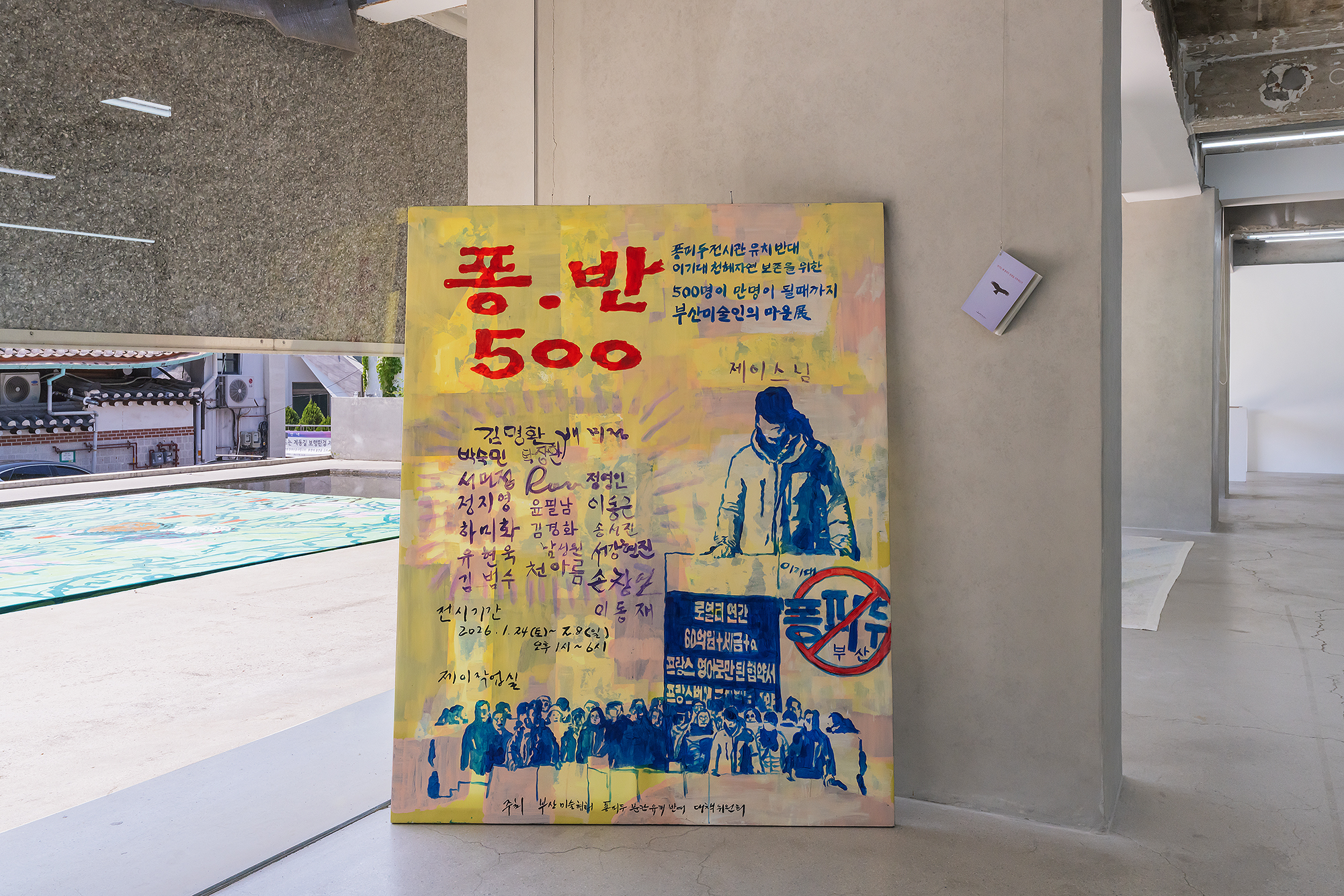
방정아는 1990년대 초부터 개인의 신체를 휘감고 억압하는 다양한 정체를 탐색해 왔다. 서로를 탐하고 질투하는 응시의 교차, 가난과 폭력 등의 사회 구조, 동류 의식과 적대감을 동시에 품는 집단성, 시절 별로 달라지는 환상의 층위, 삶과 한 쌍인 죽음 등. 이와 함께 작가는 첨예한 현안을 그림 안으로 들여오는데, 정작 화면에 보이는 것은 일종의 우화였다. 가령, 전시장 초입에 위치한 〈폭격(착시)〉(2018)는, 북한의 미사일 시험 발포 등에 관한 알림/뉴스를 보고 개와 걷던 산책길 중, ‘쿵’ 소리를 내며 떨어진 배를 포격으로 오인했던 순간을 ‘환상적 풍경’으로 재구성한다. 〈버튼을 향해 가는 괴물의 손〉(2018)의 ‘장대한 서사시’는 오염수 방출과 피폭 등의 위험이 도사리는 노후 원자력 발전기 정지와 해체 문제를 다루고 있다. 그런가 하면, 《퐁피두 부산 분관 반대 500 작가》 전 포스터는 부산 남구의 도시자연공원 ‘이기대’에 퐁피두센터 분관을 세우려는 시도를 비판한다. 작가는 해당 사안이 지역 사회 및 예술 공동체와의 논의 없이 졸속 처리된 데에 항의하고 이에 관심을 촉구하며 전시를 열고, 폐현수막을 가져다 직접 포스터로 만들었다. 이러한 작업들은 분명 현실 개입의 의지를 담고 있다. 하지만 작가가 다큐멘터리즘적 태도를 보인다고 하기는 어렵고, 대신 그림은 그 같은 현실이 너와 나의 삶을 엮고 있음을 감각으로 드러낸다.
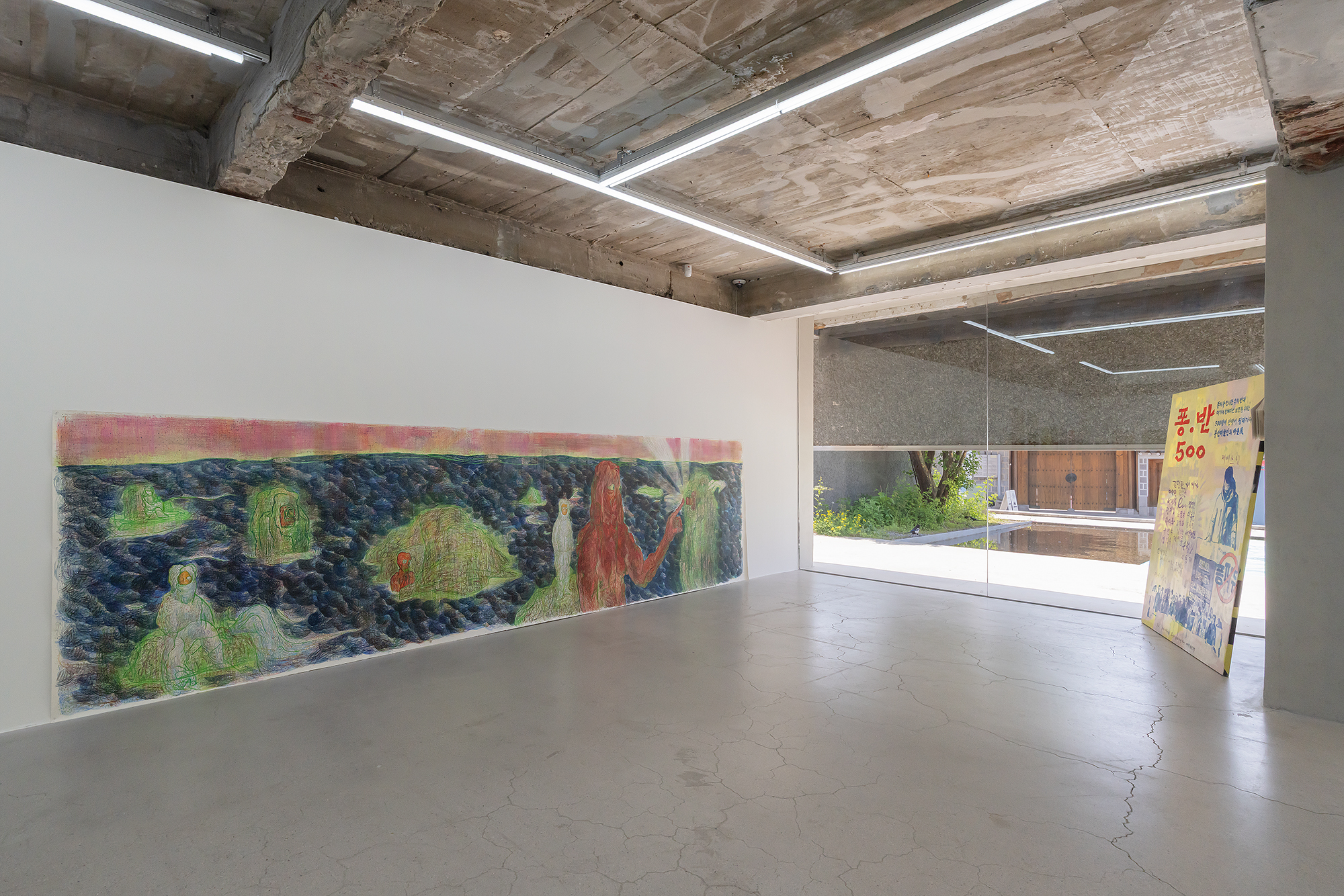
바로 이 지점에서, 방정아 작업의 표현 방식과 물성이 중요하게 부각된다. 특히 최근 작업에서는 선의 쓰임이 두드러지는데, 작가는 밑그림을 그리고 그것을 점차 발전시키는 식으로 작업하며, 추후 서로 어긋나는 선들을 지우기보다 그대로 살려두고 또 연장했다. 결국 형상은 다른 요소들에 대해 독립적인 영역으로 간주되지 않고, 흔들리고 침범되며 오해되는 진동으로 나타나게 되었다. 한편, 방정아는 이미 사용한 종이나 천 등을 새로운 그림의 바탕으로 다시 쓰거나, 버려진 천가지, 이웃에서 수거한 옷과 이불 등에 그림을 그렸다. 말 그대로 그림은 경계 없는 사물로 재사용되고 변형되며 이동한다. 일례로, 〈뒷모습〉(2018) 연작은 커다란 낡은 천에 오일 파스텔로 짧은 선을 노동집약적으로 채워 넣은 그림이다. 사라져 가는 사람들의 뒷모습에서 불꽃 또는 나무를 보았다는 작가의 말처럼, 그림은 또렷한 윤곽 대신 점점이 인상이자 나부끼는 감각으로써 ‘존재’를 포착하게 한다. 야외 공간을 가득 채우고 있는 〈욕망의 거친 물결〉(2023)은 단순한 선으로 물결을 표현해낸 동명의 그림을 폐현수막에 다시 그린 것이다. 거대한 스케일에 납작 누워 있는 그림은 가까이서는 한눈에 다 볼 수 없고, 이층에 올라서면 표정 없는 얼굴들이 물 위로 동동 떠 있는 장면이 드러난다. 전시 진행 동안 형상은 빛과 물에 장시간 노출되면서는 결국 스러지게 될 텐데, 이와 함께 시대의 욕망에 휩쓸리고 있는 얼굴들의 미래는 부정적으로 전망되는 듯하다.
주한별은 2024년 첫 개인전을 전후로 ‘포스터’가 가지고 있는 정치성에 주목해왔다. 포스터는 기본적으로 정보 전달의 성격을 가지고 있으며, 주목을 끄는 양식화의 매체다. 작가는 각종 포스터 양식, 즉 상업적 성격을 띤 광고, 의제를 던지는 사회정치적 도구, 또는 교육적 성격을 띤 선전물 등을 다양하게 추적하며 그 특성을 눈여겨 보았다. 그러는 한편, 도심 곳곳의 포스터들이 닳고 헤지는 과정들도 함께 관찰했다. 이를 회화에 일면 차용하면서 주한별은, 포스터의 ‘명징함’을 희구하는 동시에 그것이 실효를 다 하거나 의도와 달리 미끄러지는 순간들도 표현하게 되었다. 작가는 개인전 당시 선보인 〈3×3 갈비〉(2024) 등의 작업에 관해, “아무데나 붙고 아무렇게나 철거되는, 손상될 준비를 하고 있는, 잔뜩 비를 맞아서 너덜거리는, 접착력이 거의 날아갔거나 녹아 들러붙은 종이테이프에 의해 겨우 의존하고 있는 그 이미지와 메시지에 매료되었음을 고백한다.”[4] 이를테면, 전시장 초입의 〈무제〉(2023)는 손바닥만 한 크기의 패널 위 종이에 연필로 그림을 그린 뒤 마감하고, 다시 그것을 떼어낸 후 덧대는 식으로 진행한 콜라주-드로잉 연작 중 하나로, 어느 낡은 벽의 테이프 자욱에 눌러 붙은 파리 한 마리를 떠올리게 한다. 요컨대, 주한별에게 포스터는 그것이 ‘새것’이던 시절의 메시지를 기억하는 사람과 이미 그것이 ‘오래된 것’이 되어 버린 후에 흔적을 마주한 사람 사이의 시간과 의미를 조우케 하는 형식이다.
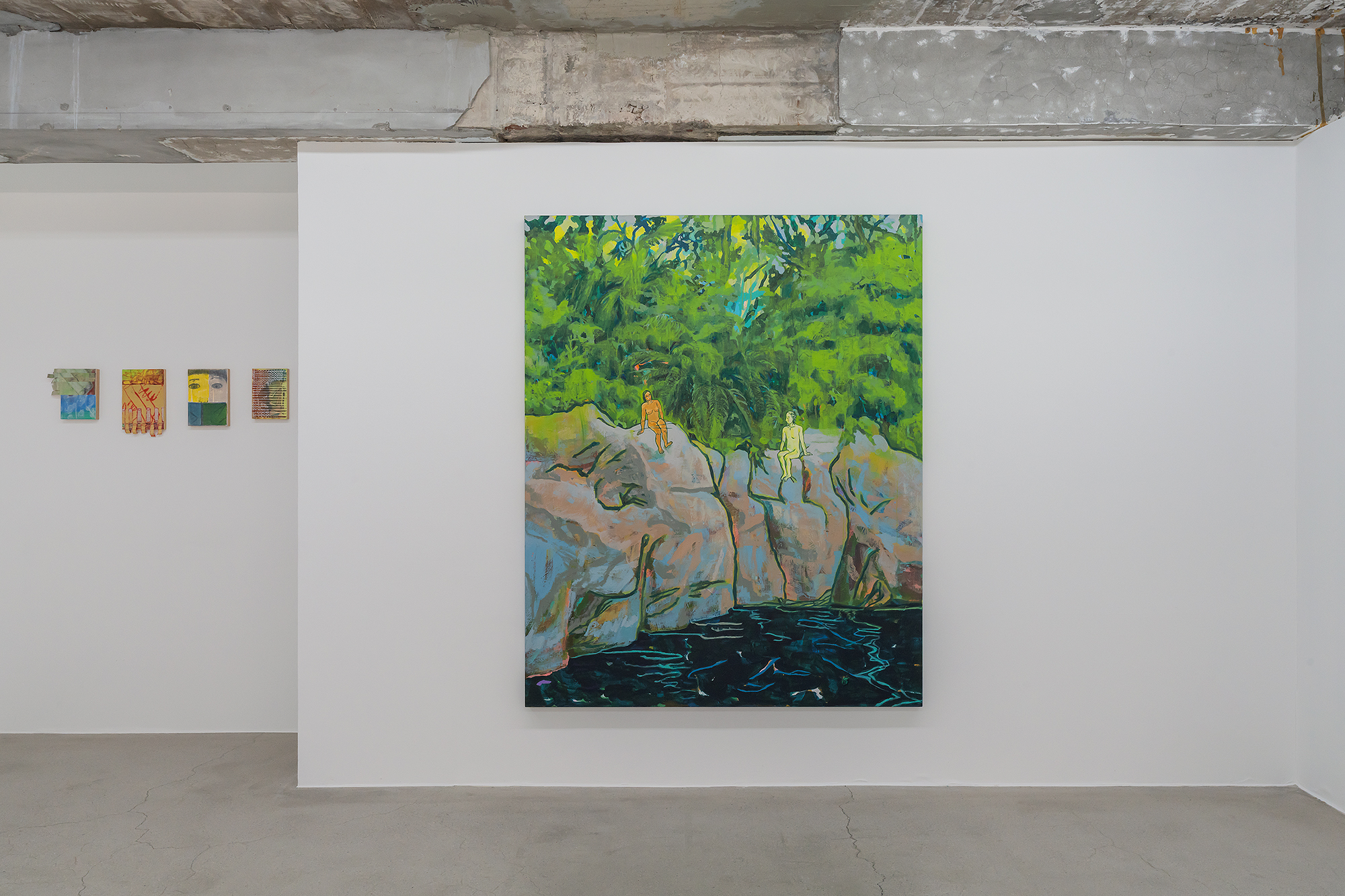
이번 전시를 위해 제작된 A1, A2 사이즈 종이의 그림들은, 포스터 형식에 대한 주한별의 관심을 계속 보여주면서도 새로운 문제를 제기한다. 콜렉티브 활동을 통해 사회의 상실과 애도를 다뤄 온 작가는, 이번 전시를 통해선 이미지로써 사건을 재현하는 문제가 자신에게 왜 중요한지, 정작 그것이 제 ‘삶’과는 어떻게 붙어 있어야 하는지를 의심해본다. 〈이빨 좀 보여줘봐〉(2026)에서 커다랗게 그려진 입은, 부서진 치아 사이로 말 대신 흰소리만 웅얼거리는 스스로에 대한 책망 내지는 검열을 드러내면서, 세대가 공유하는 ‘살아있음’에의 부채감과 말하기의 죄의식을 표현한다.[5] 전시장 안쪽 공간을 채우고 있는 포스터 형 종이 그림들에는 텅 빈 말풍선을 내뱉는 얼굴들, 침대에 누워 생각의 꼬리를 늘이고 또 가위질하는 과정, 안경 또는 마스크 뒤에 숨어서 보는 눈, 비대한 생각의 구름과, 무언가 터져 나오지 못하고 꽉 막혀버린 신경 다발 등이 보인다. 여기서 연필로 긋고 눌러 그린 뒤 바인더를 입혀 선을 흐리고 번지게 만드는 방식과, 여러 번 덧댄 표면을 다시 매끈하게 만드는 공정은 다시 한번 작가의 자기 모순을 드러낸다. 아늑한 작업실에서 ‘그림 그리기’에 전념할 수 있는 자신이 세상을 향해 말한다는 것이, 부조리를 등지고 소리치는 모양은 아닌지 재차 묻는 것이다.
방정아와 주한별, 두 작가는 그리기가 발언이 될 수 있다는 믿음을 공유한다. 다만, 방정아가 1980년대 후반 청년 학생 운동 세대의 직접적인 영향 아래 낙관의 향수를 지니고 있는 데 반해,[6] 주한별은 2010년대 이후 정설이 된 출구 없는 신자유주의에서의 무력감을 체득한 채 그 불가능을 실험한다는 차이가 있다. 정도의 차이는 있으나, 두 작가에게 회화는 현실을 은유와 상징 차원에서 드러내는 가시화의 장이다. 전시는 그렇게 무언가를 ‘보이게’ 하는 중인 크고 작은 그림들이 임시적으로 공간을 점유하고 발생시킨 메시지를 들여다본다. 특징적이게도 두 작가의 그림은 벽에 박제되거나 오브제로서 화석화하기보다, 낡아 짓이겨지더라도 퍼져 나가 흔적을 남기려는 의지를 드러낸다. 전시는 얇은 종이/천을 지지체 삼는 평면에 주의를 기울이고, 그것이 펄럭이며 관객에게 의미를 소통하는지 좇아가 본다.
물론, 여전히 현실은 오인된다. 정오 · 가부 · 진위의 판별이 불가능한 지점에 오늘의 이미지가 놓여 있다. 《파리 Flyers》가 진행 중인 이곳에서도 상황은 마찬가지다. 공간을 가득 채우는 대형 설치부터 손바닥 크기의 작은 그림까지, 전시장 안팎에서 관객은 이들을 보려 하고 보아야 할 것이며 또 ‘보는 일’에 부딪히게 된다. 의심은 여전하다. 이 이미지는 저 이미지와 달라질 수 있을까? 전시는 “보기를, 볼 수가 없[는] (I could not see to see -)”[7] 상태를 진단하고 재현하며 비평하길 시도한다. 그리고 보이는 데서 보는 일을 다시 시작하길, 화면 사이에 끼어 든 한 마리 파리 같은 이미지들을 찾아보길, 그것을 맨눈으로 마주보길 제안한다.
기획/글 허호정
[1] 디킨슨 시에는 제목이 없다. 사후 발간된 전집에서 연대 순으로 번호가 매겨졌다. 인용은 “I heard a Fly buzz – when I died”로 시작하는 465번 시를 직역한 것으로, 원문은 에밀리 디킨슨 아카이브(Emily Dickinson Archive (edickinson.org))에서 필사본과 함께 찾아볼 수 있다: https://curiosity.lib.harvard.edu/emily-dickinson-archive/catalog/195-EDA0812_F591A .
[2] 김경하, “남북이 주고받아온 삐라의 어원과 역사”, 『연세춘추』(2024.11.17. 16:35): https://chunchu.yonsei.ac.kr/news/articleView.html?idxno=31723 .
[3] 조르주 디디-위베르만은 ‘Papillon’의 두 개 의미 작용(전단과 나비)을 분석하는 한편, 밤나방(phalène)의 변태(métamorphose), 불길에 뛰어듦 등의 속성을 이미지의 출현 원리로 사유한다. 다음을 참고. Georges Didi-Huberman, Phalènes – Essais sur l’apparition, 2 (Paris: Les Éditions de Minuit, 2013).
[4] 주한별, 개인전 《망각은 모두가 가진 기능》(2024)을 위한 ‘작업 노트’ 중.
[5] “‘내가 살아남았다’는 명제는 ‘그들이 죽었다’라는 명제와 뗄 수 없이 묶여 있다. 환언하면, 나의 생존과 동일시되어야 하는 것은 누군가의 죽음이다. 그가 죽었기 때문에 내가 살아남았다는 것. 이 인식이 윤리적 사고의 시발점이다. 여기서 하나의 물음이 제기된다. 즉, 타자의 죽음과 나의 생존이 분리되지 않을 때, 우리는 과연 자신의 생존을 기뻐할 수 있는가? 견딜 수 있는가?”: 김홍중, 『서바이벌리스트 모더니티』(서울: 이음, 2024), 27.
[6] 방정아는 〈물의 친구들 30 – 숙자의 과거〉(2022)가 이러한 향수를 담고 있다고 말한다. 그림은 80년대 후반 학생 운동 당시, 어느 교정의 건물을 점거한 대학생들이 폐쇄된 농성장의 담벼락에 걸터앉은 모습을 촬영한 기록사진에서 출발했다.
[7] 에밀리 디킨슨, 위의 시, 마지막 행.
***
𝑭𝒍𝒚𝒆𝒓𝒔
BANG Jeong-A · JOO Hanbyul
1.May – 20.June 2026
12:00-19:00(closed on Sun, Mon)
Curatorial team: HUR Hojeong , KWON Hyukgue
Exhibition Assistance: KWON Hajeong, HAN Hui
Graphic Design: IN Hyunjin
Technical support: KIM Byungchan
Organized by Museumhead
Supported by Arts Council Korea
(…) – and then it was
There interposed a Fly –
With Blue – uncertain – stumbling Buzz –
Between the light – and me –
And then the Windows failed – and then
I could not see to see –
Emily Dickinson, “I heard a Fly buzz-when I died” (1863)[i]
Images, some images are like flies. They intrude even before you notice it, annoying you, at times clustering into a black swarm so dense that they become indistinguishable. They carry a kind of irreverence that disturbs the safety of present. While such images flutter, it becomes difficult to see the world as before. At the moment of death, a faint buzzing at the ear, a small flutter casting by the window.
The exhibition’s title, Flyers, refers to paper leaflets—often called “삐라 ppira” (propaganda flyers) in Korean. While Korean word 삐라 ppira has come to signify something subversive or illicit, the word is thought to derive from the Japanese word, hira (平)[ii], meaning a flat sheet of paper. Meanwhile, the French word papillon, which shares a similar meaning, also signifies “butterfly.”[iii] Imagine lifting a bundle of papers and scattering them into the air. Like fragile-winged insects (butterflies, moths, flies…), they flutter toward unsuspecting, unguarded people without any expectation.
Flyers explore the possibility of discovering this quality of images in the paintings of BANG Jeong-A and JOO Hanbyul. What we await are images that clash with their time raising their voices, and images that scatter into the air rather than take root and stand still; images that slowly metamorphose, flickering while bearing their traces, images that disrupt rigid orders. The exhibition poses a question through this lens: in an age when everything becomes (or must become) an image, can this image here become a different kind of image?
Since the early 1990s, BANG Jeong-A has searched diverse power relations that envelop and oppress an individual body: intersecting gazes of desire and jealousy; social structures of poverty and of violence; collectivity that contain both solidarity and hostility; layers of fantasy that shift over time; and death as inseparable from life. Alongside this, when the artist brings current social issues into her work, what appears on the canvas is a kind of fable. For example, Bombing (Optical Illusion) (2018), placed at the entrance of the exhibition, reconstructs as a “fantastical landscape” moment when the artist mistook the sound of a falling pear for a bombing while walking a dog, hearing news alerts about North Korean missile test. The Monster’s Hands on the Button (2018)’s “epic narrative” addresses the dangers surrounding aging nuclear power plants in Busan, including contaminated water discharge and radiation exposure. Meanwhile, the artist made a poster with discarded banner and as a result, The Poster for the exhibition Anti-Pompidou Busan 500 criticizes the attempt to build a branch of the Pompidou Center in Igidae, a natural urban park in Busan’s Nam-gu district. She protested the rushed decision made without sufficient discussion with the local community by organizing an exhibition to raise awareness. These works clearly express a will to intervene in reality, yet rather than adopting a documentary stance, her paintings sensorially reveal how such realities are entangled with our lives.
At this point, the expressive method and materiality of BANG’s works come to the fore. In her recent works, the use of line is especially prominent. She begins with a sketch and gradually develops it, leaving misaligned lines intact and extending them, rather than erasing. As a result, figures are no longer treated as independent entities but appear as shifting, intruding, and misread vibrations in a work. Meanwhile, she also reuses previously used paper or fabric as the ground for new paintings, or paints on discarded cloth, collected clothing, and bedding. In this sense, her paintings literally become boundary-less objects, moving reused and transformed. For instance, the Back View (2018) series consist of labor-intensive short lines drawn with oil pastel across large, worn, discarded fabric. As the artist has remarked—seeing flames or trees in the backs of people disappearing—the works captures “being” not through clear outlines but as scattered impressions and fluttering sensations. Rough Waves of Desire (2023), which fills the outdoor space, reimagines a painting of waves drawn with simple lines onto discarded banners. Spread flat on a massive scale, it cannot be seen at once from up close; from the second floor, however, expressionless faces floating on water come into view. As the work is exposed to light and water over time, it will eventually fade, suggesting a gloomy outlook for those faces swept up in the desires of the generation.
JOO Hanbyul, around her first solo exhibition in 2024, has focused on the political nature of posters. Posters are vehicles of information and stylized media designed to attract attention. The artist has closely observed various poster formats of commercial advertisements, socio-political tools that raise agendas, and educational propaganda, while also noting how posters in urban spaces wear down over time. Incorporating these observations into painting, the artist seeks both the “clarity” of posters and moments when their effectiveness fails or slips away from intention. Reflecting on works such as 3×3 Rib (2024), the artist has stated “an attraction to images and messages that are ready to be damaged and pasted anywhere, torn down carelessly, soaked in rain, tattered, barely clinging by weakened or melted adhesive tape.”[iv] For instance, Untitled (2023), at the exhibition’s entrance, is part of a collage-drawing series in which a small sheet of paper is drawn on, finished, peeled off, and reattached to a panel evoking a single “fly” stuck to the adhesive traces on an old wall. For JOO, the poster becomes a form that makes it encounter different temporalities and meanings between those who remember its message when it was “new” and those who meet only its traces after it has become “old.”
The works on A1 and A2-sized paper produced for this exhibition continue to show JOO’s interest in the poster format while raising new questions. Where her previous collective practice addressed social loss and mourning, the artist here turns inward, reflecting on why representing events as images matters to her, and how such representation should connect to her own life. In Show Me Your Teeth (2026), a large mouth mumbles nonsense through broken teeth — revealing self-reproach or censorship, and expressing a generational sense of indebtedness to being “alive” and a guilt associated with speaking.[v] In the poster-like works filling the inner exhibition space, we can find faces emitting empty speech bubbles, figures lying in bed extending and cutting off trains of thought, eyes hidden behind glasses or masks, swollen clouds of thought, and blocked bundles of nerves unable to release what is trapped within. Drawing with pencil, pressing lines, then applying binder to blur and spread them, layering surfaces repeatedly and smoothing them again reveals the artist’s self-contradictions, questioning whether speaking to the world from the comfort of a studio might amount to crying out against injustice while having one’s back turned to it — whether the gesture itself is already a contradiction.
BANG Jeong-A and JOO Hanbyul share a belief that painting can be a form of speech. Yet there is a difference: BANG retains a nostalgic optimism rooted in the student activist movements of the late 1980s,[vi] whereas JOO experiments from within a sense of impossibility and powerlessness pervasive in post-2010 neoliberal conditions. There are varying degrees, but the medium of painting for both artists is a field of visualization where reality is revealed through metaphor and symbolism. The exhibition examines the messages generated as these large and small paintings temporarily occupy space and make something “to be seen.” Notably, their works resist being fixed as objects or fossilized on walls; instead, even as they age and are worn down, they seek to spread and leave traces. The exhibition attends flat surfaces supported by thin paper or fabric, tracing how they flutter and communicate meaning to viewers.
Of course, reality continues to be misrecognized. Today’s images exist in a space where distinctions between truth and falsehood, affirmation and denial, become impossible. The same holds even while the exhibition Flyers is on view. From large-scale installations in the outdoor space to palm-sized works, viewers encounter these images both inside and outside the exhibition, compelled to see and confronted with the act of seeing. The question persists: can this image differ from that image? The exhibition attempts to diagnose, reproduce, and critique a condition of “could not see to see.”[vii] It proposes that we begin again from what is visible: to seek out images like flies that have slipped between the frames, and to face them with bare eyes.
HUR Hojeong
Curator, Museumhead
[i] Dickinson’s poems have no titles. They were numbered chronologically in the posthumously published collected works. This quotation is a direct translation of Poem No. 465, which begins “I heard a Fly buzz – when I died.” The original text, along with manuscript facsimiles, can be found in the Emily Dickinson Archive: https://curiosity.lib.harvard.edu/emily-dickinson-archive/catalog/195-EDA0812_F591A .
[ii] Kim Gyeongha, “The Etymology and History of Ppira Exchanged Between North and South Korea,” Yonsei Chunchu (November 17, 2024, 16:35): https://chunchu.yonsei.ac.kr/news/articleView.html?idxno=31723
[iii] Georges Didi-Huberman analyzes the dual significations of papillon (flyer and butterfly), while also theorizing the metamorphosis of the moth (phalène), its propulsion into flames, and other such qualities as principles underlying the appearance of images. See: Georges Didi-Huberman, Phalènes – Essais sur l’apparition, 2 (Paris: Les Éditions de Minuit, 2013).
[iv] JOO Hanbyul, from the “Artist’s Note” written for the solo exhibition Forgetting Is a Function Everyone Has (2024).
[v] “The proposition ‘I survived’ is inextricably bound to the proposition ‘they died.’ In other words, what must be identified with my survival is someone else’s death — that I survived because they died. This recognition is the starting point of ethical thought. A question arises here: when the death of the other and my own survival cannot be separated, can we truly rejoice in our survival? Can we bear it?”: Kim Hongjung, Survivalist Modernity (Seoul: Eueum, 2024), 27.
[vi] BANG Jeong-A has noted that Friends of Water 30 – The Past of Sukja (2022) carries this sense of nostalgia. The painting originates from a documentary photograph taken during the student movement of the late 1980s, showing university students perched on the wall of a sealed protest building on a campus.
[vii] Emily Dickinson, the poem cited above, final line.