





《안은미조각쑈》
안은미 개인전
2026년 8월 29일–10월 3일
뮤지엄헤드, 서울 종로구 계동길 84-3, 1층 및 야외
12:00–19:00 (일, 월 휴관)
글: 이정우-임우근준
프로덕션매니저: 김성빈
구조물 디자인: 김동희
구조물 설계 및 제작: 박수민
그래픽 디자인: 조경규
사진 촬영: 조준용, 노송희
주최, 주관: 뮤지엄헤드
후원: 한국문화예술위원회, 시각예술창작주체 2026
협찬: 래코드 RE;CODE
춤이 조각을 불러 세우는 까닭
— 신인 조각가 안은미의 첫 개인전에 부쳐
1. 전도된 데뷔: 나이를 먹고 신인으로 거듭나는 길
데뷔의 준비는 길었고, 순서는 전도됐다. 안은미는 활동 초기부터 현대미술의 시공에 나란히 서 있었다. 1991년 제1회 MBC 창작무용경연대회 우수상을 안긴 〈도둑비행〉에서 타악 연주자 김대환, 미술가 최정화와 협업했고, 1992년 호암아트홀과 신세대 공간 ‘오존’에서 선보인 〈아릴랄 알라리요〉—무대를 맡았던 최정화가 지금도 걸작으로 꼽는—로 개발 독재 시대의 버내큘러를 전유하는 신세대 예술의 감각을 주도했다. (당시 활동은, 나카무라 마사토의 사진 기록으로도 남았다.)
그러나 미술 제도의 시공이, 최정화, 이불, 이수경 등과 어울려 놀던 이 문제적 무용가를 포용하기까지, 거의 한 세대의 시간이 소요됐다. 안은미는 2009년 백남준아트센터 제1회 국제예술상을 공동 수상하며 〈백남준 광시곡〉을 벌였다. 동원된 피아노 74대 가운데 24대가 크레인에 매달려 공중으로 올라갔고, 넥타이로 지은 웨딩드레스를 입은 작가는 밤하늘로 날아올라 도끼와 가위로 끈을 끊어버림으로써 마지막 한 대를 낙하시켰다. 백남준에게 바치는 헌사이면서 고인이 된 백남준과 올리는 영혼 결혼식이기도 했다.
이후 십년 만이었던 2019년, 서울시립미술관 개인전 《안은미래》로 미술관 제도 비평 이후의 시공을 창출했다. 안은미의 미술관은, 전시 이상의 일들이 벌어지는 총체적 경험의 장이었다. 전시 기간 내내, 《안은미래》는 배움의 시간을 가질 수 있는 ‘몸춤’, 강연과 토론을 나누는 ‘입춤’, 그리고 리허설하는 모습을 참관할 수 있는 ‘눈춤’으로 구성된, 일종의 대안적 아방가르드 예술학교가 됐다. 이러한 확장된 실천 양태는, 2022년 부산시립미술관의 《나는 미술관에 ●●하러 간다》를 거쳐, 2024년 베니스 산 자코모 섬의 〈핑키핑키굿〉에 이르렀다. 나병 환자들을 격리하는 섬이기도 했던 산 자코모에서, 안은미는 꼭두 군상의 조각 〈아가까까〉를 선보였고, 도록에는 ‘신인 조각가 안은미’의 선언문 가안이 실렸다. 그리고 올해, 데뷔전을 앞둔 이 신인은 광주 국립아시아문화전당과 서울시립 서서울미술관에서 대규모 조각 설치를 잇달아 선보이며 그 문법을 한 번 더 갱신-심화했다.
안은미가 갱신 중인 선언문은, 개인의 출사표라기보다 우리 시대의 처방전에 가깝다. 각 세대가 이전 세대의 문화적 접근을 부정하면서도 구미를 문화적 ‘원본’으로 인식하는 모순—안은미가 ‘탈식민적 세대 부정 연쇄’라 부르는—을 끊고, 아시아와 아프리카의 직접 교류로 새로운 문화적 정당성의 체계를 세우자는 제안이다. ‘신인 되기’는 그 처방의 실천 형식이다. 예술가의 전성기가 길어야 십 년이라는 통설에 맞서, 안은미는 시기마다 거듭나는 변신의 연대기를 설계해 왔다. 스스로 밝힌 야심은 “죽을 때까지 이어질 아흔아홉 가지의 메타모포시스”다. 그러니 ‘신인’은 겸양의 수사가 아니라 갱신의 방법론이고, 이미 조각을 전시해 온 조각가가 여는 데뷔전이라는 전도된 순서야말로 그다운 방식이다. 이력이 먼저 오고, 데뷔가 나중에 온다. 바뀌어서 되는 것이 아니라 원래 그것이었음이 뒤늦게 인정되는 수순—강신무의 입무 서사에서 반복되는 현현(顯現)의 형식이다. 신병을 앓던 이가 원래 신을 모실 몸이었음을 내림굿으로 공인받듯, 이 데뷔전에는 입무 의례의 성격이 깃들어 있다.
2. 삶과 죽음 사이, 경계의 사물 친구들
뉴욕 시절의 안은미는 〈하얀 무덤〉에서 〈토마토 무덤〉과 〈빈 무덤〉을 거쳐 〈꽃 무덤〉까지 이어진 무덤 연작(1993-1998)으로, 근원적 공포의 초현실적 이미지들을 무대에 쏟아냈다. 죽고 또 죽어야 다시 살아날 수 있다는 믿음의 실천으로 비춰졌다. 무덤 연작이 시작되던 1993년에 피의 춤인 〈달거리〉로 탄생 에너지의 폭력성을 다뤘으니, 무덤 연작과 〈달거리〉는 상징 차원에서 하나의 세트였던 셈이다.
2000년 귀국해 2004년까지 대구시립무용단장으로 일하며 〈은하철도000〉(2001), 〈하늘고추〉(2002) 등 화제작을 연달아 발표했고, 2004년부터 2005년까지 〈렛츠 고〉·〈렛 미 체인지 유어 네임〉·〈렛 미 텔 유 썸씽〉 삼부작을 발표하며 자신만의 추상적이면서도 구체적인 춤 생성 문법―춤이 아닌 보통의 몸쓰기와 몸동작을 바탕으로 삼는―을 총정리했다. 이후 그는 차차 포스트모더니즘의 문법에서 벗어나는 길로 나아갈 수 있었다. 바리데기 서사를 재창조한 〈심포카 바리〉 이승-저승 2부작(2007-2010)으로 저승길의 시간을 탐험했고, 2011년작 〈조상님께 바치는 댄스〉를 필두로 하는 무용 인류학 연작으로 국제적 스타덤에 올랐다.
1990년대 뉴욕의 평단은 이 세계를 두고, 죽음을 지향함으로써 이승을 강조하는 부토에 대한 화답으로 읽었다. (1997년 제니퍼 더닝은 〈레인보 카페〉를 일본 부토에 대한 한국적 응답일 가능성 속에서 읽었고, 이듬해 〈별이 빛나는 밤〉에서는 안은미의 눈부신 시각적 상상력과 마법을 높이 평가했다.) 청년 시절의 안은미는 삶을 과도하게 지향함으로써 죽음을 강조했던 것일까?
무덤 연작의 존재론적 슬픔과 공포에서 꼭두의 귀엽지만 무시무시한 위로까지, 길도 답도 매번 바뀌었다. 그러나 문제는 하나였다. 죽은 자는 공동체의 기억 속에선 쉽사리 소멸하지 않으며, 산 자와 죽은 자들은 따로 또 함께 사는 법을 찾아내고야 만다는 것. 천도재와 유교 제례와 해원굿 등이 저마다의 글자로 거듭 써온 그 오랜 문제의 최신 답안이 이 전시의 사물들이다. 죽음(과 삶)의 의례는 안은미에게 소재가 아니라 문법이고, 그 문법의 목적어는 언제나 삶(과 죽음)이다.
한데 그 문법을 이끄는 힘은 색으로부터 온다. 안은미는 유년기에 회색의 산업도시에서 색색의 전통 의복을 입고 춤추던 이들을 목격하고 춤에 입문했다고 회고한다: “내게 춤은 동작이 아닌 색으로 각인됐다.” 색채의 움직임에서 안무를 도출하는 이 감각을 그는 크로마아니미즘(Chromanimism)의 세계관으로 발전시켰고, 삶과 생명 예찬의 예술을 색의 향연으로 펼쳐왔다. 베니스의 굿이 핑크의 향연이었다면, 지난 5월 광주의 굿은 보라의 의례였다. 안은미의 세계에서 색은 장식이 아니라, 죽음의 사물을 삶의 축제로 반전시키는 부활과 접신의 스위치로 작동한다.
3. 상호조우체, 혹은 네 번째 방법론
이는 네 번째 방법론—정확히는 넷째 항이라기보다 앞선 셋을 관통하는 형식—의 이름으로 읽을 만하다. 안은미는 이미 세 가지 방법론을 손아귀에 쥔 예외적 안무가다. 첫째는 〈하늘고추〉(2002)로 확립한 한국식 탄츠테아터, 둘째는 〈렛츠 고〉(2004)에서 개시한, 실재계에서 뜯어온 버내큘러 동작을 반복-변주해 추상적 질서로 구축하는 얼터-모던의 메타-추상, 셋째는 할머니-청소년-아저씨로 이어진 무용 인류학 3부작(2011-2013)이다. 상호조우체는 이 세 방법론이 극장 바깥으로 확장될 때 취하는 형식—무대와 객석의 위계 없이, 물질과 관계로 안무를 확장하는—이며, 《안은미조각쑈》는 그 형식이 마침내 ‘조각’의 이름을 얻는 자리다.
이 확장에는 계보적 배경이 있다. 한때 유럽 무대를 풍미한 포스트드라마틱시어터가 환영을 거부하고 권력으로서의 극장을 드러내는 제도 비평의 방법을 취했다면, 안은미는 〈조상님께 바치는 댄스〉 이래 실재계와 극장 사이의 위계를 편평하게 만들고, 거기서 수집한 요소로 극장을 그 일부로 재정의하는 길을 걸었다. 상호조우체는 그 편평화의 논리적/실천적 귀결이다. 극장이 실재계의 일부라면, 굳이 극장일 필요도 없다. 광장이, 섬이, 미술관이, 계동의 마당이 차례로 무대가 된다.
실제로 올해 5월부터 7월까지, 서울시립 서서울미술관의 개관 특별 소장품전 《서서울의 투명한 |청소년| 기계》에서 안은미는, 2012년 〈사심 없는 땐쓰〉에서 출발한 소장 작품을 〈(이름을 지어 주세요)〉와 별이 하나씩 늘어나는 〈천차만별별〉 연작, 거울 장막 〈천하중첩도〉의 설치 환경으로 확장한 〈핑크박스〉를 선보였다. 장영규의 2012년 사운드가 흐르고, 거울과 영상 속에서 십사 년 전 청소년의 군무가 지금 관람자의 몸 위에 겹쳐 내려앉는 이 방에서, 무용 인류학은 물질과 환경의 문법으로 번역됐다. 지나간 무대는 보관되는 대신 오늘의 몸을 다시 움직이는 장치가 됐고, 여러 참여 프로그램에서 움직임을 만들고 나눈 주역은, 안은미 외 춤교사로 나서준 킹키, 이지, 김강민 등 댄서/안무가와 또 자발적으로 참여한 청소년 여러분이었다.
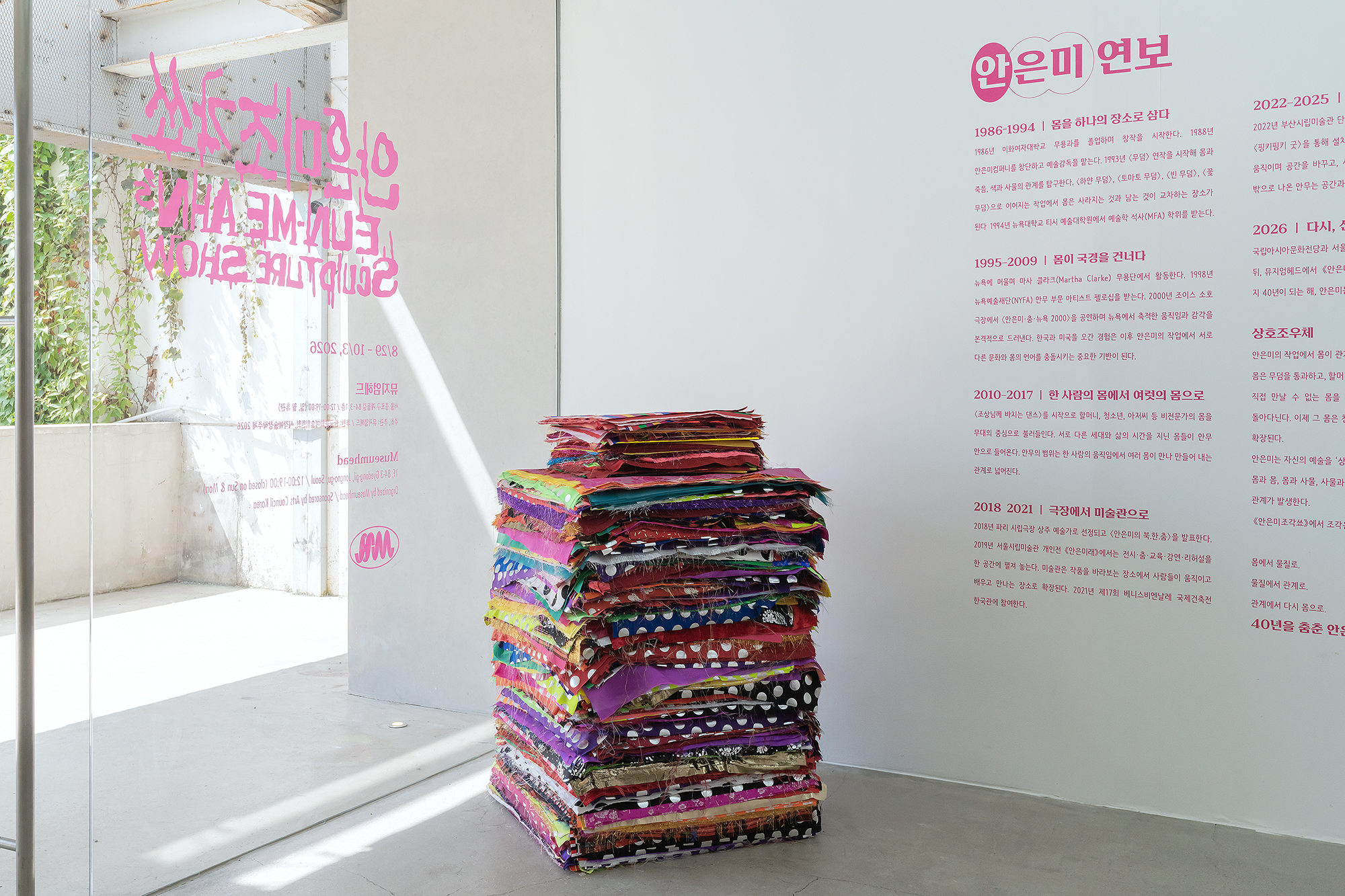
따라서 여기서 조각은 완결된 물체가 아니라 사이에서 발생하는 상태다. 퍼포먼스의 흔적은 통나무·천·획·인형으로 응축돼 전시장에 잔존하지만, 그것은 지나간 사건의 기록이나 재현이 아니라 계속되는 실천의 약속, 수행의 표지로 작동한다. 몸에서 물질로, 물질에서 관계로, 관계에서 다시 몸으로 옮겨 다니는 순환의 매듭들. 현대조각의 오랜 정의가 공간 속의 정지된 재귀적 매체 성찰의 덩어리였다면, 안은미의 조각은 통과되고, 밟히고, 건너지고, 덧쌓이기를 기다리는 관계의 기점을 지향한다.
4. 광주(전남광주통합특별시)의 광산동에서 서울의 계동까지
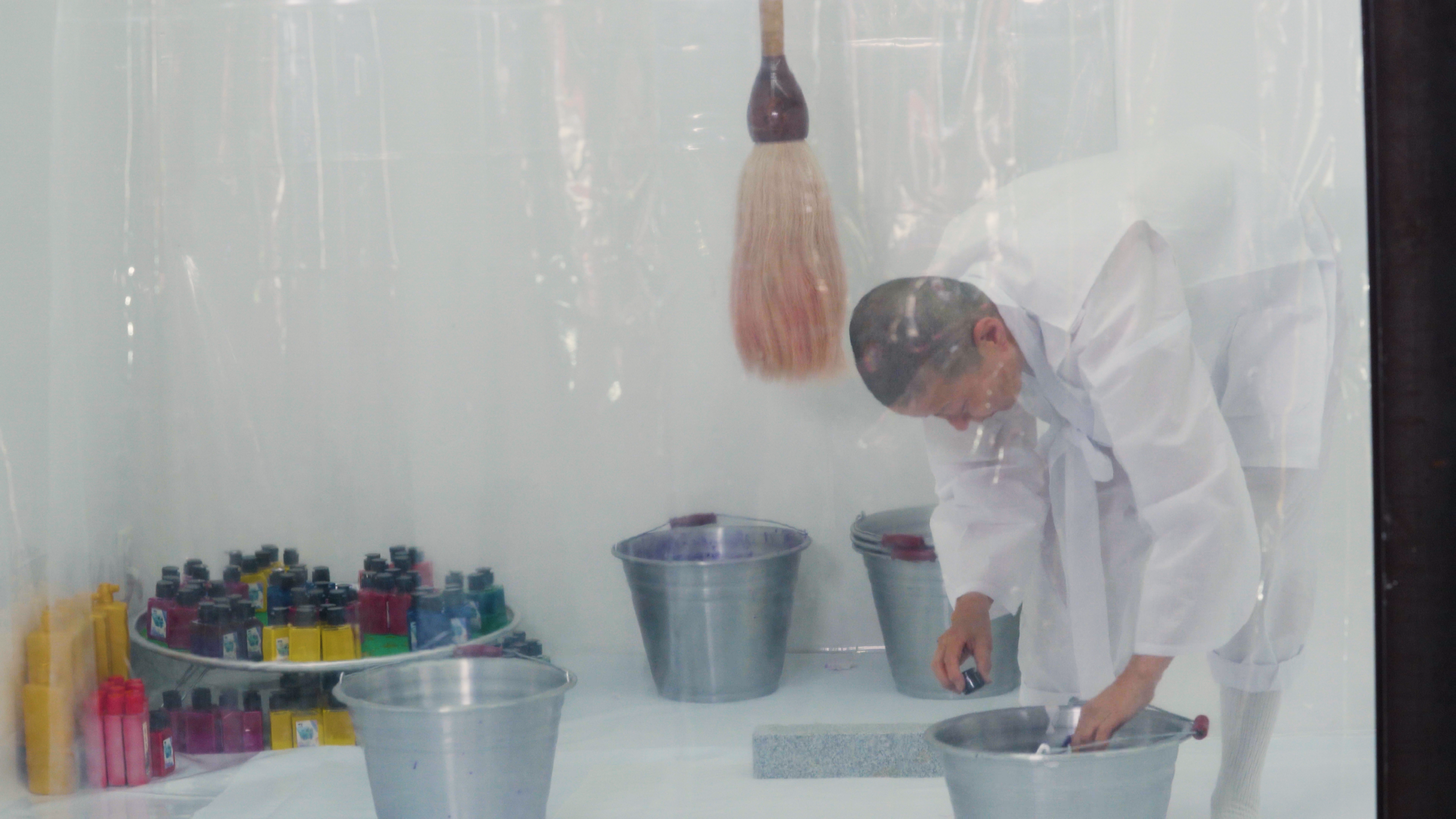
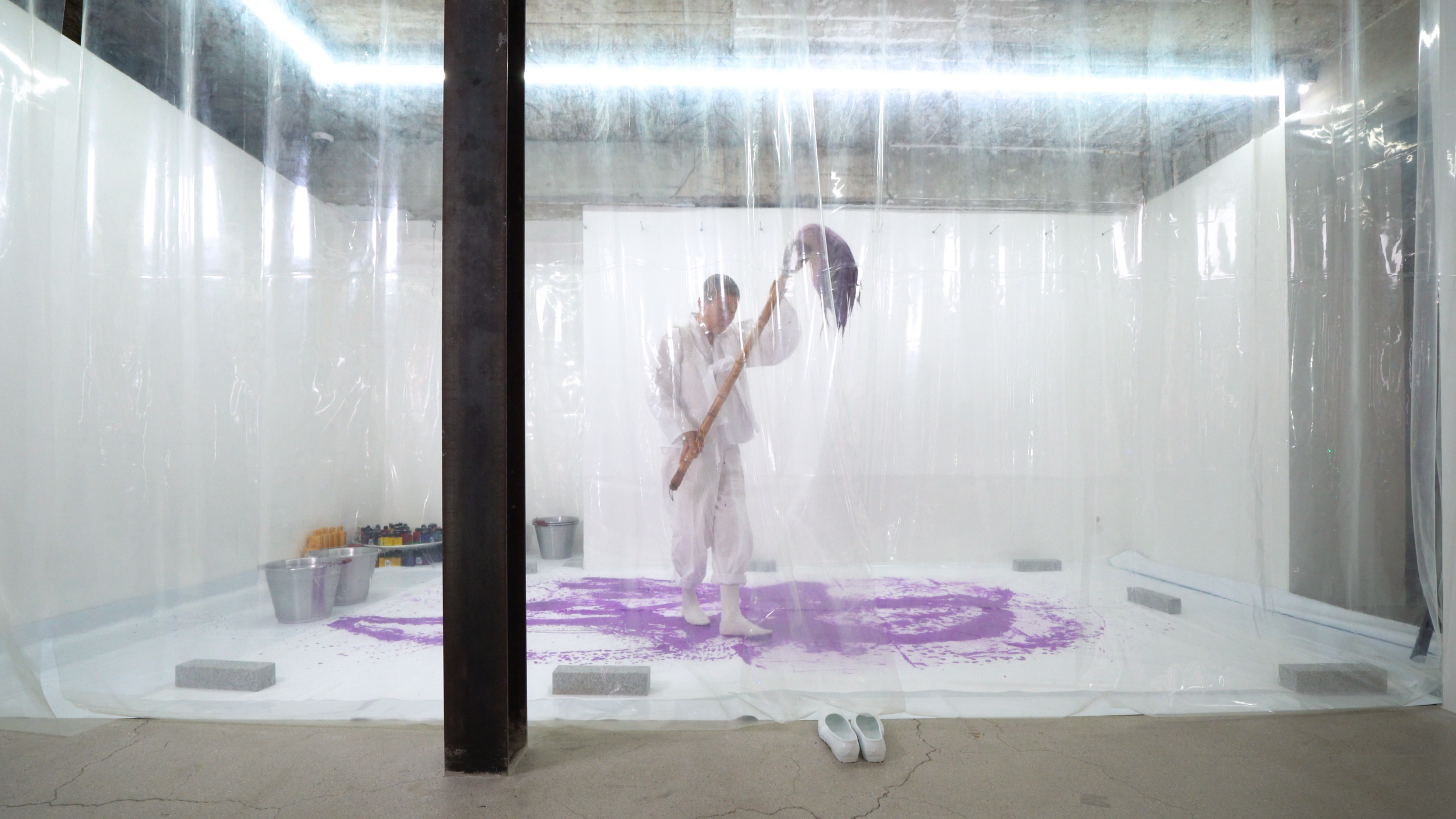
구성의 참조점은 조선의 책가도와 기명절지화다. 개막일의 굿(〈산다선다굿굿〉)에서 굿패는 동방미래초령대(招靈臺)를 앞세워 장막을 통과해 제단 앞에 모였다가, 관객과 함께 아시아문화광장으로 나갔다. 베니스의 〈핑키핑키굿〉(2024)과 과천의 〈오하나굿(5=1굿)〉(2025)에서 이어진 이 굿판은, 광주민주화투쟁의 성과와 상처를 과거의 사건으로 봉인하는 대신 민주 공동체의 집합적 감각을 현재의 신체 행위로 호출했다. 동해안 별신굿의 소리와 테크노 사운드가 병치-중첩되는 음향 속에서, ‘산다’와 ‘선다’는 선언이 아니라 반복 수행되는 상태였다. 광장에 펼쳐진 100미터의 천 위에서 작가는 거대한 붓으로 춤추며 보라색 획을 긋고 물로 씻어냈으며, 굿이 끝난 뒤 그 천은 통나무에 감기고 흰 지전의 머리를 얹어 토템으로 거듭났다. 긋고, 씻어내고, 감고, 덧얹는 공정이 일궈내는 이 토템은 문자 그대로의 중사본(重寫本, palimpsest)—앞선 층을 다 지우지 못한 채 다시 쓰이는 다층 레이어의 몸이다.
계동의 뮤지엄헤드에서 열리는 이번 전시는 그 총연습의 응축이자 변주다. 국립기관의 광장을 지나 도착한 곳이 북촌의 작은 마당이라는 사실도 전도의 일부다—데뷔의 무대는 커지는 대신 작아졌다. 계보를 따라가 보자. 1993년 〈달거리〉에서 안은미는 하얀 거즈천 조각을 풀과 실로 이어 붙인 옷을 입고 춤을 췄다. 옷만 보면, 상징 차원에서 인간 달거리포(조선시대 생리대)가 된 셈이었다. 2024년, 그 매체로서의 흰 섬유조직은 몸을 떠나 5미터 높이의 지전 장막이 됐고, 한 명의 유령이 그 사이를 오가며 옷을 하나씩 벗고 다시 입기를 반복했다. 지난 5월 광주에서는 미래의 제단을 품은 장막을 굿패와 관객이 함께 넘나들었다. 그리고 이번에는 유령마저 사라진다.
마당 거울못 위에 18겹의 지전 벽(약 5.8×12m)이 설치된다. 그 사이를 지나갈 수 있도록 물 위로 굽은 징검돌다리가 놓인다. 돌들은 한때 그릇이었고 잔이었고 거울이었던 것들의 파편을 몰탈 위에 촘촘히 박아 결속한 둥근 몸이다(〈Please Come Walk With Us〉). 정연한 간격도 예측가능한 보폭도 없으니, 걷는 이는 매 걸음 방향과 보폭을 다시 가늠해야 한다. 감싸인 몸에서 왕복하는 유령으로, 유령에서 굿패와 관객으로, 그리고 이제 관객의 두 발로—‘전달-매개자(Conduit-Mediator)’의 자리는 그렇게 스무 해 남짓에 걸쳐 지속적으로 이양돼 왔다. 판본은 매번 바뀌었다. 지속되는 것은 형상이 아니라 건너야 할 금도와 벌려야 하는 틈이고, 새 판본은 그리 수정된 경계와 틈 위에 다시 쓰인다. 바람이 지전을 흔들고 물이 그 흔들림을 되비추는 회랑을 다 건너기 전까지, 걷는 이는 이승도 저승도 아닌 시공의 창출에 동참한다.
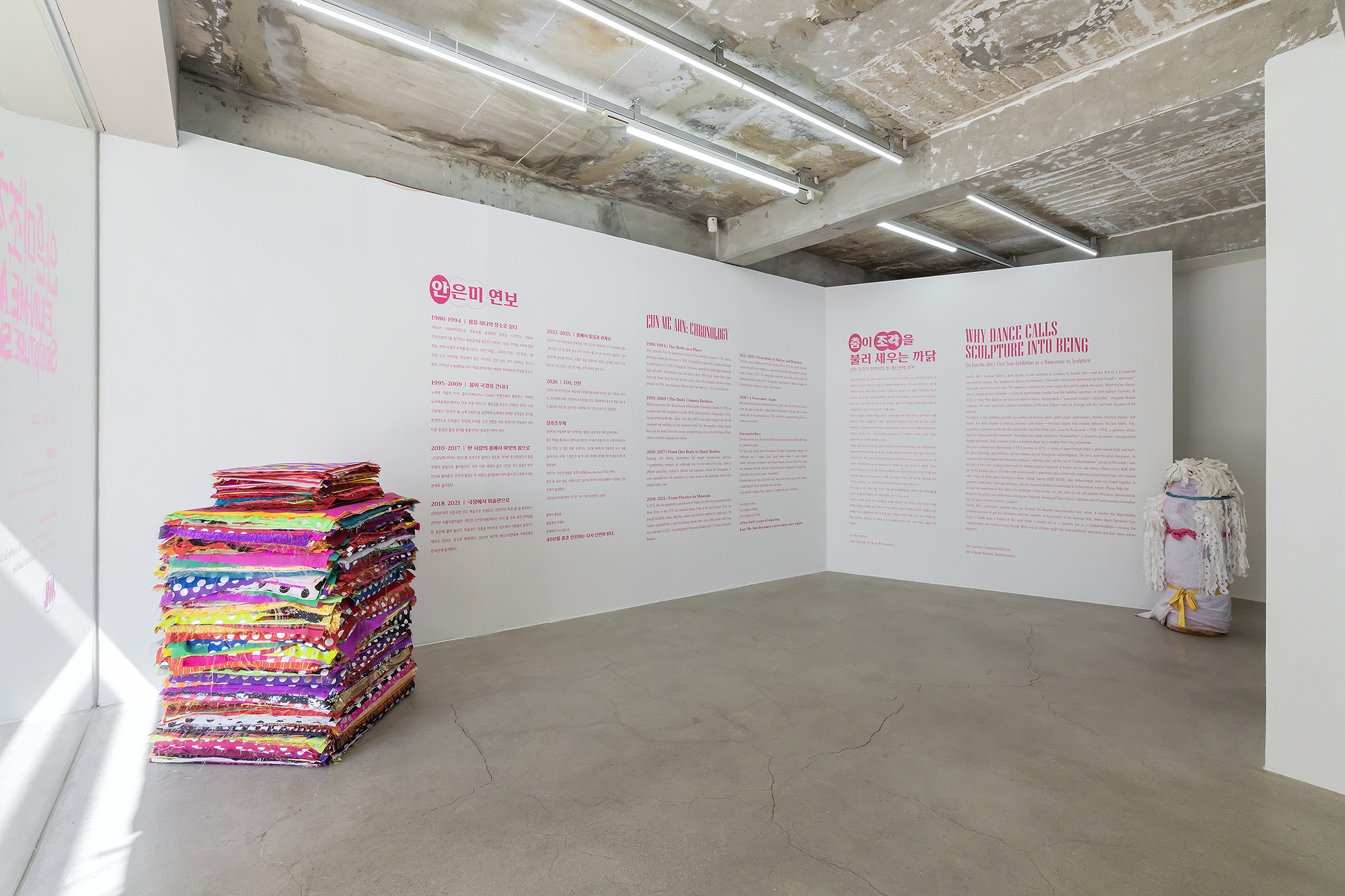
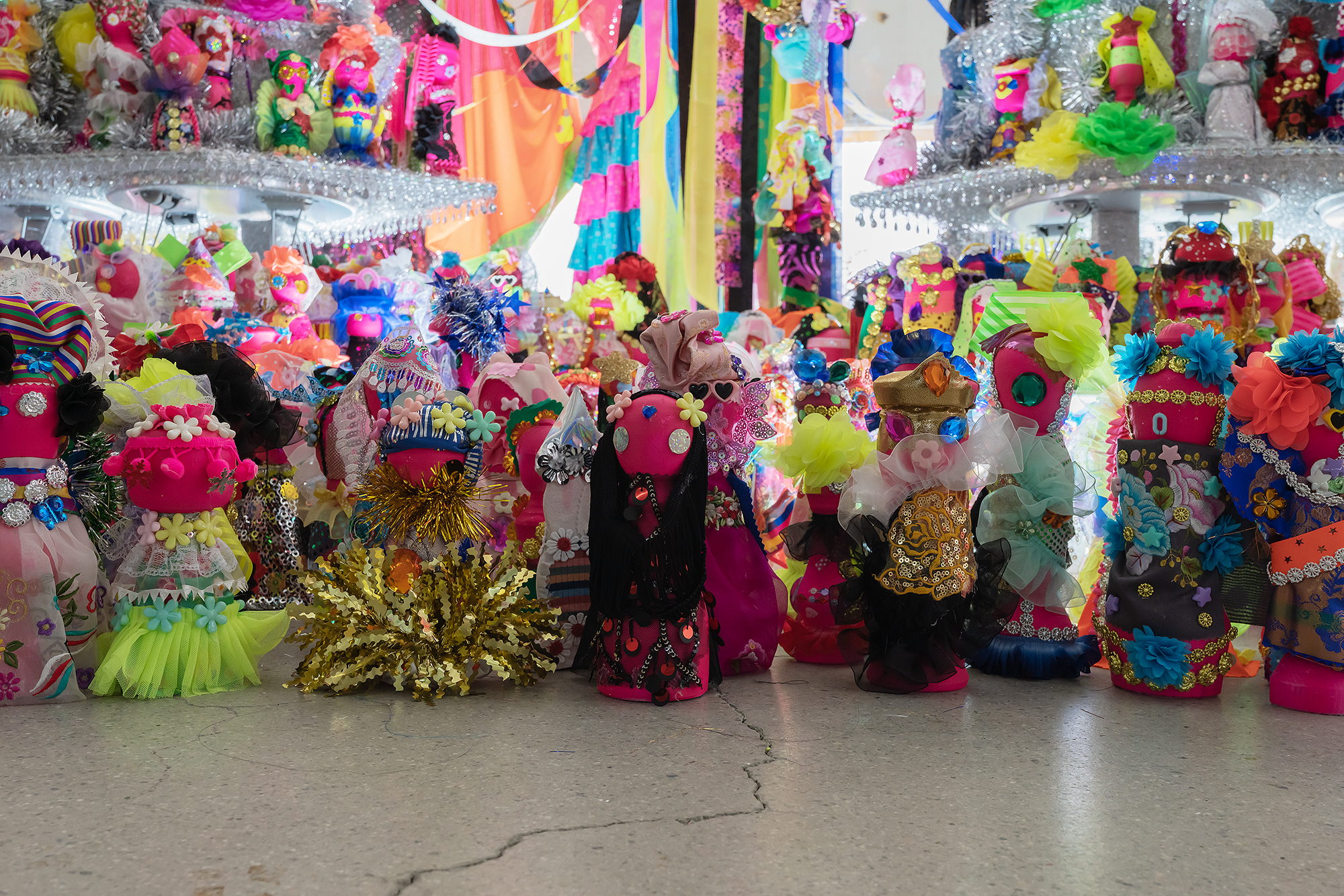
전시장 안쪽도 같은 원리로 짜였다. 광주의 토템 가운데 두 몸이 여기 서 있다(〈산다선다굿굿〉). 사진과 영상이 사건을 재현한다면, 이 통나무들은 사건이 아직 끝나지 않았음을 말하는 표지다. 아홉 그루의 옷걸이-나무는 천으로 서로 묶이며 보이지 않는 열 번째 몸을 발생시킨다(〈서낭서낭〉). 서낭당의 형상을 재현하는 대신, 나무에 천을 묶는 반복 행위가 시간에 따라 하나의 장소를 형성하는 축적과 결속의 구조를 가져온 결과다. 몸을 대신하던 옷걸이가 나무의 골격이 되고, 나무와 나무의 연결이 다시 몸이 된다. 하나가 흔들리면 그 흔들림은 천을 타고 다른 몸으로 건너간다. 그리고 손으로 깎은 천 개의 꼭두가 3단의 매안에 안치된다(〈플리즈헬프미〉).
아가는 아직 말을 배우지 않은 유아를 부르는 말이고, 까까는 그러한 아기의 입이 처음 배우는 말이다. 장식 사탕 같은 얼굴을 한 이 존재들의 정체는, 이승에서 저승까지의 먼 길을 망자와 함께 걷던 꼭두—슬픔을 대신 짊어지지는 않지만, 그 길에서 혼자가 되지 않도록 곁을 지키는 동행자다. 일부는 투명 아크릴 상자에 개별 봉인되고, 매안 전체는 자개를 연상시키는 붉은 장 속에 다시 안치된다. 겹겹이 봉해질수록 안의 존재는 더 조용해지고, 더 또렷해진다.
5. 수행과 실천의 시간
날짜도 시간도 예고되지 않으니 수행은 정해지지 않은 순간에 오고, 서른여섯 날 가운데 열여덟 날의 몸짓이 축적되어 마지막에 하나의 작업으로 모인다. 몸이 그린 획은 회화가 되고, 회화는 반복과 확장을 통해 공간의 표면으로 이동하며 순간성을 지속성으로 전환한다. 검무(劍舞)의 칼이 베어내던 자리에 붓은 스미고 번진다—무기의 춤 다음에 물질의 춤이 있음을 묻는 수행. 조각전의 한가운데로 춤과 그림의 시간이 흐르고, 전시는 폐막일까지 스스로의 완성을 유예한다. 열여덟 번의 일회적 쑈가 켜켜이 쌓여 ‘조각’이라는 중사본이 되는 셈—제목의 ‘조각’과 ‘쑈’는 여기서 한 몸이 된다.
6. 굿은 먼저 알고 있었다
붓은 각기 다른 몸짓을 요구하는 행위자고, 바람과 물은 배경 연출이 아니라 인과의 중개자이며, 발밑의 돌은 다음 걸음의 위치와 보폭을 함께 정하는 존재다. 조각이 완결된 물체가 아니라 사이에서 발생하는 상태라는 안은미의 명제는, 상호-내작용의 무속적 번역처럼 들리고, 상호조우체는 작품-관객 결합체라는 새 객체의 다른 이름처럼 들린다. 겹겹이 봉해질수록 안의 존재가 더 또렷해지는 〈플리즈헬프미〉의 역설은, 물러나는 객체가 감각의 표면에서 번쩍인다는 알뤼르(allure)의 정의를 그대로 상연-증거하고, 설명 없이도 몸이 먼저 알아채는 〈산다선다굿굿〉의 통나무는 어떤 환언(paraphrase)으로도 소진되지 않는 잔여로 서 있다. 그러나 인과의 방향을 뒤집어 읽어야 옳다. 안은미가 신유물론을 예시하는 것이 아니라, 신유물론이 뒤늦게 도착한 자리에 굿이 먼저 와 있었다. 사물에 영이 깃들고, 물질이 행위하며, 색이 생명을 예찬하고, 인간이 단독 주연의 자리에서 내려와 매개자가 되는 세계—무속과 꼭두와 서낭의 버내큘러는 그 세계를 오랜 세월 문법으로 보유해왔다. 크로마아니미즘은 그 문법의 동시대적 재가동이고, 물질이 오브제가 아니라 인프라로 전면화되리라는 전망에는 스스로 ‘인간 인프라스트럭처’가 되겠다는 작가의 각오가 이미 응답하고 있다.
물론 이러한 선취는 본질의 전승에 있지 않다. 지속된 것은 알맹이가 아니라 다시 쓰는 방식이며, 원형을 고수하는 전통은 제힘만으론 되살아나지 않는다/못한다. 안은미는 그 문법을 지금의 재료 위에 소환-재기입하는 행위자다. 뒤늦게 인정되는 ‘원래’조차, 층층이 쌓여 만들어진 판본인 셈이다. 구미 이론이 ‘전회’라 부르며 새로 배우는 것을 의례의 전통으로 물려받은 자리에서 출발한다는 것—여기에 이 신인 조각가가 수행하는 탈식민주의 비평의 미덕이 있다. 인간을 단독 원인의 자리에서 끌어내리는 미술사의 재서술이 시작된다면, 그 첫 장에 놓일 사례 하나가 여기 있다.
7. 위로의 자리
이정우-임우근준 (미술·디자인 이론/역사 연구자, 메타-드라마터그)
Why Dance Calls Sculpture into Being
— On Eun-Me Ahn’s First Solo Exhibition as a Newcomer to Sculpture
1. A Reversed Debut: Growing Older, Becoming New Again
The preparation for this debut was long, and the sequence reversed. From the beginning of her career, Ahn was already working in close proximity to contemporary art. In Dodukbihaeng (“Thief Flight”), which won an Excellence Award at the first MBC Creative Dance Competition in 1991, she collaborated with percussionist Kim Dae-hwan and artist Choi Jeonghwa. In A-Li-Ral-Al-La-Li-O, presented in 1992 at Hoam Art Hall and the new-generation space Ozone—with a stage by Choi, who still calls it a masterpiece—she helped shape a new-generation artistic sensibility that appropriated the vernacular of Korea’s developmental-dictatorship era. Nakamura Masato’s photographs also preserve traces of these activities.
Yet it took almost a generation for the institutional world of contemporary art to embrace this unruly dancer, who moved in the same circles as Choi Jeonghwa, Lee Bul and Yeesookyung. In 2009, Ahn became a joint recipient of the inaugural Nam June Paik Art Center Prize and staged Nam June Paiks Rhapsody. Of the seventy-four pianos used, twenty-four were hoisted into the air by cranes. Wearing a wedding dress made of neckties, the artist rose into the night sky and cut the ropes with an axe and scissors, sending the final piano crashing down. It was both a tribute to Nam June Paik and a spirit wedding with the deceased artist.
A decade later, in 2019, her solo exhibition Known Future at the Seoul Museum of Art created a museum space that moved beyond institutional critique. Ahn’s museum became a field of total experience in which far more than an exhibition took place. Throughout its run, Known Future operated as a kind of alternative avant-garde art school, composed of “body-dance” for learning, “mouth-dance” for lectures and discussion, and “eye-dance” for observing rehearsals. This expanded mode of practice continued through the Busan Museum of On my way to the Museum in 2022 and Pinky Pinky Good on San Giacomo Island in Venice in 2024. On San Giacomo, once also used to isolate people with leprosy, Ahn presented Aga Kkakka, an assembly of kkokdu sculptures, while the catalogue included a draft declaration by “newcomer sculptor Eun-Me Ahn.” This year, before her debut exhibition, the newcomer further renewed and deepened this grammar through successive large-scale sculptural installations at the Asia Culture Center in Gwangju and the Seo-Seoul Museum of Art in Seoul.
The declaration Ahn continues to revise reads less like a personal manifesto than a prescription for our time. It proposes breaking what she calls the “postcolonial chain of generational negation”: the contradiction in which each generation rejects the previous generation’s cultural approach while continuing to regard Europe and America as the cultural “original.” In its place, she proposes a new system of cultural legitimacy built through direct exchange between Asia and Africa. “Becoming a newcomer” is the practical form of that prescription. Against the cliché that an artist’s prime lasts ten years at most, Ahn has designed a chronology of repeated transformations. Her stated ambition is “ninety-nine metamorphoses continuing until death.” “Newcomer,” then, is not modest rhetoric but a methodology of renewal. The reversed sequence of a sculptor who has already exhibited sculpture now holding a debut show is precisely her way: the career first, the debut afterwards. One does not become something by changing; rather, what one has always been is recognised belatedly—a form of manifestation recurring in the initiation narratives of spirit-medium shamans. Just as naerim-gut, a ritual in which a shaman formally receives her spirit confirms that a person afflicted by spirit sickness was always a body destined to receive a deity, this debut exhibition carries the character of an initiation rite.
2. Between Life and Death: Object-Friends of the Threshold
During her New York years, Ahn poured surreal images of primal fear onto the stage through the Tomb series (1993–1998), from White Tomb through Tomato Tomb and Empty Tomb to Flower Tomb. It appeared as a practice of the belief that one must die and die again in order to live again. In 1993, the year the Tomb series began, she also addressed the violence of birth energy through the blood-dance Menstruation; symbolically, the Tomb series and Menstruation formed a pair.
Returning to Korea in 2000, Ahn served as artistic director of the Daegu City Dance Company until 2004, producing much-discussed works including Galaxy Express 000 (2001) and Sky Pepper (2002). From 2004 to 2005, with the trilogy Let’s Go, Let Me Change Your Name and Let Me Tell You Something, she consolidated her own grammar for generating dance—at once abstract and concrete, and grounded in ordinary bodily actions and gestures rather than “dance” as such. She gradually moved beyond the grammar of postmodernism. In the Symphoca Bari diptych (2007–2010), which recreated the Bari-degi narrative across this world and the next, she explored the temporality of the road to the afterlife; with Dancing Grandmothers (2011) and the dance-anthropology series that followed, she rose to international prominence.
New York critics in the 1990s read this world as a response to Butoh, which emphasised this life by orienting itself towards death. In 1997, Jennifer Dunning considered Rainbow Café as a possible Korean answer to Japanese Butoh; the following year, writing on Starry Night, she praised Ahn’s dazzling visual imagination and magic. Was the young Eun-Me Ahn, conversely, emphasising death through an excessive orientation towards life?
From the ontological sadness and fear of the Tomb series to the cute yet terrifying consolation of kkokdu, both route and answer changed each time. The question remained one: the dead do not easily disappear from communal memory, and the living and dead inevitably find ways to live separately and together. The objects in this exhibition are the latest answer to an old problem repeatedly written in different scripts by Buddhist cheondo-jae rites, Confucian ancestral ceremonies and shamanic haewon-gut. For Eun-Me Ahn, rituals of death (and life) are not subject matter but grammar, and the object of that grammar is always life (and death).
The force driving this grammar comes from colour. Ahn recalls entering dance after seeing people in colourful traditional dress dancing in the grey industrial city of her childhood: “For me, dance was imprinted not as movement but as colour.” She developed this capacity to derive choreography from the movement of colour into a worldview she calls Chromanimism, unfolding an art that celebrates life and vitality as a feast of colour. If the Venice gut was a feast of pink, last May’s Gwangju gut was a ritual of purple. In Ahn’s world, colour is not decoration but a switch of resurrection and spirit-contact, turning objects of death into a festival of life.
3. Encounterface, or a Fourth Methodology
It can be read as the name of a fourth methodology—less a separate fourth term than a form running through the previous three. Ahn already commands three methodologies: a Korean Tanztheater established with Sky Pepper (2002); an alter-modern meta-abstraction initiated with Let’s Go (2004), repeating and varying vernacular movements extracted from the real and building them into abstract order; and the dance-anthropology trilogy of grandmothers, teenagers and middle-aged men (2011–2013). Encounterface is the form these methodologies take as they expand beyond theatre, extending choreography into matter and relation without the hierarchy of stage and auditorium. Eun-Me Ahn’s Sculpture Show is where that form finally acquires the name “sculpture.”
This expansion has a genealogy. If postdramatic theatre rejected illusion and exposed theatre as a structure of power through institutional critique, Ahn, since Dancing Grandmothers, has worked to flatten the hierarchy between reality and theatre and to redefine theatre as one part of reality, using elements gathered from it. Encounterface is the logical and practical consequence of that flattening. If theatre is part of reality, there is no reason it must remain inside a theatre: a plaza, an island, a museum and a courtyard in Gye-dong become stages in turn.
From May to July this year, in the opening collection exhibition The Transparent/Adolescent/Machine of Western Seoul at the Seo-Seoul Museum of Art, Ahn presented Pink Box, expanding a collection work that began with Selfless Dance (2012) into the installations Please Name Me, the Cheoncha Manbyeol Byeol series, in which stars multiply one by one, and the mirrored curtain Cheonha Jungcheopdo. With Jang Young-gyu’s 2012 sound playing, the group dance of teenagers from fourteen years earlier overlapped with the bodies of present-day visitors through mirrors and video. Dance anthropology was translated into a grammar of matter and environment. Rather than preserving the past stage, the work turned it into a device for moving bodies today; across the participatory programmes, movement was created and shared by Ahn, dance teachers and dancer-choreographers including Kinky, EZ and Kim Kang-min, together with teenagers who joined voluntarily.
Sculpture here is therefore not a completed object but a condition arising in-between. Traces of performance condense into logs, cloth, strokes and figures and remain in the gallery, but they function not as records or representations of a past event, but as promises of continuing practice—markers of performance. They are knots in a cycle moving from body to matter, matter to relation, relation back to body. If modern sculpture was long defined as a stationary, self-reflexive mass contemplating its medium in space, Ahn’s sculpture aims instead at points of relation waiting to be passed through, stepped on, crossed and layered over.
4. From Gwangsan-dong in Gwangju to Gye-dong in Seoul
Its compositional references are Joseon chaekgado and gimyeong jeoljihwa. In the opening-day gut, Sanda Seonda GOOD GOOD, the performers carried the Dongbang Mirae Choryeongdae through the curtains, gathered before the altar, and then moved with the audience into the Asia Culture Plaza. Continuing from Pinky Pinky Good in Venice (2024) and Ohana Gut (5=1 Gut) in Gwacheon (2025), this gut did not seal the achievements and wounds of the Gwangju Democratic Uprising into the past; it called the collective sensibility of a democratic community into present bodily action. Amid a soundscape that juxtaposed and layered the sounds of the East Coast Byeolsin-gut with techno, “living” and “standing” were not declarations but repeatedly performed conditions. On a 100-metre cloth spread across the plaza, Ahn danced with a giant brush, drawing purple strokes and washing them away with water. After the gut, the cloth was wound around logs and crowned with a head of white jijeon, becoming a totem. The process of drawing, washing, winding and layering produced a literal palimpsest—a multilayered body rewritten without fully erasing what came before.
The exhibition at Museumhead in Gye-dong condenses and varies that full rehearsal. The fact that the route from a national institution’s plaza ends in a small Bukchon courtyard is itself part of the reversal: the stage for the debut becomes smaller rather than larger. Follow the genealogy. In Menstruation (1993), Eun-Me Ahn danced in a garment made by joining pieces of white gauze with glue and thread—a symbolic human menstrual cloth. In 2024, that white fibrous tissue left the body and became a five-metre-high curtain of jijeon, through which a ghost moved back and forth, repeatedly removing and replacing clothing. Last May in Gwangju, gut performers and the audience crossed together through a curtain containing an altar of the future. This time, even the ghost disappears.
Eighteen layers of jijeon wall, approximately 5.8 × 12 metres, are installed above the courtyard reflecting pool. A curved bridge of stepping-stones crosses the water between them. The stones are round bodies made by densely embedding in mortar fragments of things that were once bowls, glasses and mirrors (Please Come Walk With Us). With neither regular intervals nor predictable strides, the walker must reconsider direction and step at every moment. From the wrapped body to the ghost moving back and forth, from the ghost to the gut performers and audience, and now to the visitor’s own two feet, the role of “Conduit-Mediator” has been continuously transferred over roughly two decades. Each version changes. What persists is not the form but the line that must be crossed and the gap that must be opened; each new version is rewritten upon that altered boundary. Until the visitor has crossed the corridor, where wind shakes the jijeon and water reflects its movement, the walker participates in producing a space and time that belong neither to this world nor the next.
The gallery interior follows the same principle. Two bodies from the Gwangju totems stand here (Sanda Seonda GOOD GOOD). If photographs and video represent an event, these logs are signs that the event has not yet ended. Nine clothes-hanger trees are tied together with cloth, producing an invisible tenth body (Seonang Seonang). Rather than reproducing the form of a seonang shrine, the work adopts its structure of accumulation and binding, in which the repeated act of tying cloth to trees forms a place over time. Hangers that once substituted for bodies become the skeletons of trees; the connections among trees become a body again. When one moves, its movement travels through the cloth to another. And one thousand hand-carved kkokdu are enshrined in a three-tiered maean (Please Help Me).
Aga names a baby who has not yet learned to speak; kkakka is among the first words such a mouth learns. These beings, with faces like decorative sweets, are in fact kkokdu—companions who walked with the deceased on the long road from this world to the next. They do not bear grief in one’s place, but stay alongside so that the journey is not made alone. Some are individually sealed in transparent acrylic boxes, and the entire maean is placed inside a red cabinet recalling mother-of-pearl lacquerware. The more layers of enclosure, the quieter and more distinct the presence within becomes.
5. The Time of Performance and Practice
Neither dates nor times are announced, so the performance arrives at an undetermined moment. Gestures from eighteen of the thirty-six days accumulate and finally gather into one work. Strokes drawn by the body become paintings; through repetition and expansion, paintings move onto the surface of space, converting ephemerality into duration. Where the sword of geommu once cut, the brush seeps and spreads—a practice asking whether a dance of matter can follow a dance of weapons. The time of dance and painting flows through the centre of a sculpture exhibition that postpones its own completion until the closing day. Eighteen one-off performances accumulate layer by layer into a palimpsest called “sculpture”: here, the title’s “sculpture” and “show” become one body.
6. Gut Already Knew
The brush is an actor demanding a different gesture each time; wind and water are not scenic background but mediators of causality; the stone underfoot helps determine the position and length of the next step. Ahn’s proposition that sculpture is not a completed object but a condition arising in-between sounds like a shamanic translation of intra-action, while Encounterface sounds like another name for the new object formed by work and viewer. The paradox of Please Help Me, in which the more deeply a being is sealed the more vividly it appears, seems to stage and demonstrate the definition of allure—the withdrawn object flashing at the surface of sensation. The logs of Sanda Seonda GOOD GOOD, recognised first by the body without explanation, stand as a remainder that no paraphrase can exhaust. Yet the direction of causality must be reversed. Ahn does not illustrate new materialism; gut was already there before new materialism arrived. A world in which spirit inhabits things, matter acts, colour celebrates life and humans step down from the role of sole protagonist to become mediators has long existed as a grammar within the vernacular of shamanism, kkokdu and seonang. Chromanimism is a contemporary reactivation of that grammar, and the prospect of matter coming to the foreground not as object but as infrastructure is already answered by the artist’s determination to become “human infrastructure” herself.
This apparent anticipation, of course, does not lie in transmitting an immutable essence. What persists is not a core but a way of rewriting; a tradition that insists on an original form cannot revive by its own power alone. Eun-Me Ahn is an agent who summons and reinscribes that grammar onto the materials of the present. Even the “original” recognised belatedly is itself a version made through accumulated layers. To begin from a place where what Euro-American theory newly learns as a “turn” has already been inherited through ritual tradition: therein lies the force of the decolonial critique performed by this newcomer to sculpture. If art history is to be rewritten by dislodging the human from the position of sole cause, here is one case that might stand on its opening page.
7. A Place of Consolation
Geun-jun Chungwoo-Michael Lim (Art & Design Historian, Meta-Dramaturg)
‘